
Did you know? · No. 27 · Trivia ·
Robots.txt reached the IETF Standards Track about 28 years after its 1994 start.
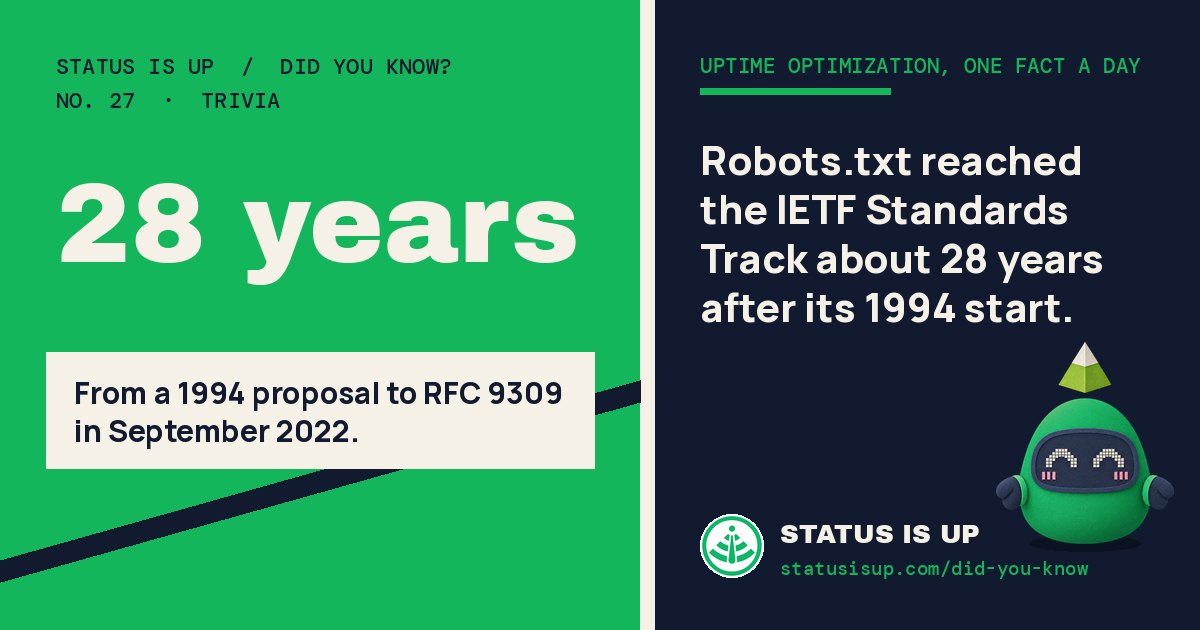
Robots.txt started in 1994, when Martijn Koster defined the Robots Exclusion Protocol to give site owners a way to tell crawlers where they may go. Search engines adopted it widely, but the protocol remained a de facto convention for decades. In September 2022, RFC 9309 documented and extended it as an IETF Standards Track Proposed Standard.
That long history is a reminder that a tiny text file can have a large effect. A rule such as `User-agent: *` followed by `Disallow: /` tells compliant crawlers not to access any path on your site. That can be useful for a private staging environment, but publishing it on a live site can stop compliant search crawlers from fetching your pages. Robots.txt controls crawling, not access security or guaranteed removal from search results.
Try this on your site
After every launch, deployment, or CMS migration, open `https://yourdomain.com/robots.txt` and review every `Disallow` rule. Test the live file in your search engine's webmaster tools before treating the launch as complete.
Share this fact
Each fact is checked against the primary sources listed. Spotted an error? Email the Status Is UP team. Status Is UP helps owners improve their sites; it is not an uptime monitor. For live outage status, see Status Is Down.