
STATUS IS UPWEBSITE OPTIMIZATION WIKI
02Enable
Optimization fundamentals / Enable

Website Uptime Readiness: Prepare Before Traffic Arrives

A practical way to prepare the paths, dependencies, limits, changes, and people that keep a website useful when demand or failure arrives.

Website Uptime Readiness: Prepare Before Traffic Arrives — VISUAL GUIDE
READ
8 minutes
SOURCES
7
REVALIDATE
2027-03-27
reviewed
Reliability and web operations reviewer
THE SHORT ANSWER

Start with the decision.

Website uptime readiness is the work of preparing important website journeys before a launch, campaign, seasonal peak, or major change. It is not a claim that the site is currently up, and it is not an alerting program. The aim is to know which journeys matter, what they depend on, where they can fail safely, who can act, and how preparation will be proved.

Start with the path that creates the most harm if it stops working: sign-in, product discovery, checkout, account access, or a support form. Map the services it uses, set a demand scenario, test the real path safely, prepare rollback and reduced-function options, and name owners with authority to act. Readiness improves options before a problem; it does not guarantee uninterrupted service.

VISUAL GUIDE

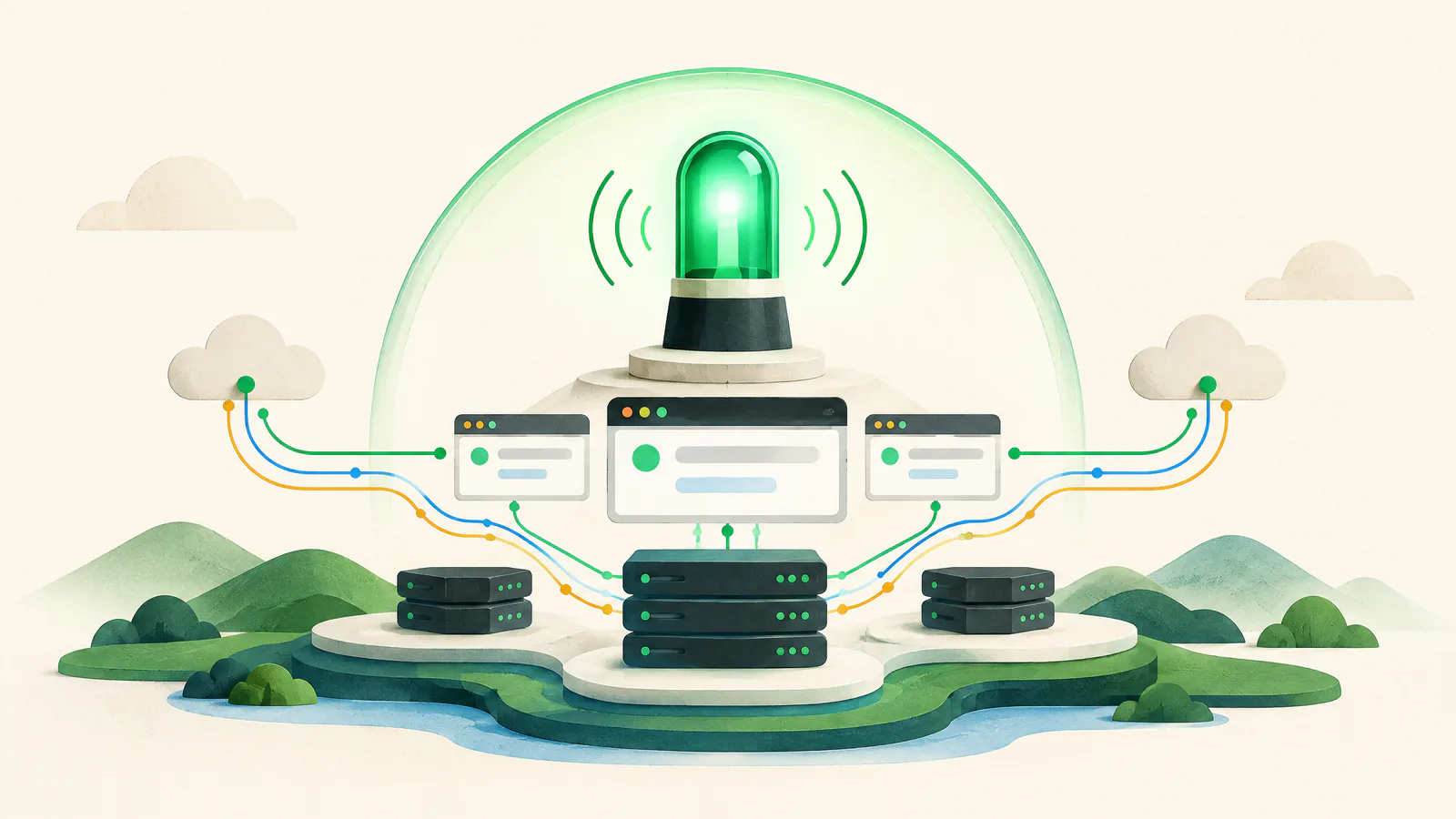
See the work as a system.

Use this map to connect the article’s decisions before acting on individual tactics.

SIUEnable
01Define readiness around a customer outcome
02Map dependencies and decide what can degrade
03Turn a traffic forecast into a capacity experiment
04Prepare change, rollback, and recovery choices
01

Define readiness around a customer outcome

Begin with outcomes, not infrastructure labels. A reachable homepage is not enough if a visitor cannot complete the task that matters. For each critical journey, state who is trying to do what, what success means, and which result is unacceptable. Start with a few journeys so the team can make real decisions.

Classify each step as essential, important, or deferrable. Essential means the journey cannot finish without it; important may permit a time-limited workaround; deferrable can be omitted, delayed, or simplified. This is a product decision informed by engineering, not a universal technical ranking.

Minimum outcome

Record a usable result, such as an order is accepted and confirmation is stored, rather than only a page-response target.

02

Map dependencies and decide what can degrade

For every critical path, map hosting or delivery, DNS, application services, databases, authentication, email, payment, search, tags, consent tooling, and external APIs. Record the owner, support route, relevant limit, and user effect if each is unavailable. OWASP recommends insight into software dependencies; the same ownership discipline helps with operational dependencies.

A hard dependency stops the task when it fails. A soft dependency can be absent or stale while the core task still works. AWS describes graceful degradation as keeping the core function available when dependencies are unhealthy. Define a product-specific choice: hide a nonessential widget, defer a report, or present an honest fallback. Do not invent inventory, prices, order states, or payment results.

Dependency record

Capture purpose, owner, known limit, fallback, change contact, and last test date for each item.

03

Turn a traffic forecast into a capacity experiment

Use a scenario, not one traffic number. State the event, arrival pattern, request mix, signed-in share, geography, concurrent checkout or write activity, and peak period. Include a high case and assumptions. Google notes that requests can have very different resource costs, so requests per second alone can be a poor capacity model.

Test sustained, representative, end-to-end traffic against a configuration close to production, with approval and safeguards. AWS cautions against testing only components, using an unrepresentative request subset, or stopping at a small margin above expected load. Document the first constraint or slowdown. Live-production tests can affect customers; use a controlled environment unless a planned, staffed exercise is appropriate.

Useful output

Keep the scenario, configuration, request mix, duration, observed constraint, capacity change, and follow-up owner.

04

Prepare change, rollback, and recovery choices

Before a high-stakes change, identify the artifact or configuration to restore, approval needed, authorized person, and validation method. Keep a short runbook for pausing a release, reverting a deployment, disabling a feature flag, reducing a noncritical integration, or restoring data using an approved procedure. Test the mechanics before the event; an unexercised backup or rollback plan is an assumption.

Set recovery objectives from business impact. Recovery Time Objective, or RTO, is the maximum acceptable delay before service is restored. Recovery Point Objective, or RPO, is the maximum acceptable data loss measured from the last recovery point. AWS warns against arbitrary or unrealistic targets and notes that dependency objectives affect what is achievable. Treat targets as planning goals, not customer promises.

Recovery proof

Verify a limited, safe rollback or restoration and record what was checked, by whom, and any gap found.

05

Assign ownership before decisions are urgent

A contact list alone is not ownership. For each critical path, assign a business owner for the acceptable outcome, a technical owner for implementation, and a decision owner authorized to make a protective change. Name backups and clarify when a provider, agency, payment processor, or internal team owns the next action.

Run a short readiness review before traffic arrives. Walk through one dependency failure: what remains available, which lever is safe, who approves it, and how success is checked. This is proactive rehearsal, not a live-status report. Record dated actions, owners, and due dates.

Decision rights

Pre-authorize narrow safe actions where appropriate so protection does not wait for an unclear approval chain.

06

Treat payment and security-sensitive paths with extra care

Checkout readiness must preserve correctness as well as availability. Do not bypass authorization, weaken access controls, expose credentials, or casually alter payment-page scripts. PCI SSC guidance addresses authorization, integrity, and tamper detection for payment-page scripts and security-impacting HTTP headers. If the site accepts cards or uses an embedded payment frame, have the merchant, processor, acquirer, and qualified security or compliance advisers review material changes.

Keep an inventory of production scripts, integrations, versions, and account ownership, and restrict who can change them. OWASP notes that dependency inventories and version pinning can reduce uncertainty about what enters a build, while automated findings still need manual verification. These practices support readiness but do not establish PCI compliance or replace a security assessment.

Payment fallback

Use only a processor-approved, reviewed alternative flow; never collect card data through informal channels.

ACTION / VERIFY

Your practical to-do guide.

  1. 01

    Choose critical paths

    List the few journeys whose failure would create the greatest harm during the event.

    VERIFY: Each has a one-sentence success condition and named business owner.
  2. 02

    Rank functions

    Mark significant steps essential, important, or deferrable, including the reduced customer behavior.

    VERIFY: Product and technical owners approve the classification.
  3. 03

    Build the dependency register

    Capture services, vendors, scripts, accounts, limits, owners, support routes, and fallbacks.

    VERIFY: Every dependency has an accountable owner and confirmed contact route.
  4. 04

    Write the demand scenario

    Describe timing, traffic mix, authenticated activity, writes, regions, and high-case assumptions.

    VERIFY: Stakeholders agree it represents planned demand, not a generic benchmark.
  5. 05

    Run a representative test

    Exercise the critical path with controlled, sustained traffic and record its first constraint.

    VERIFY: The report records configuration, request mix, duration, result, and follow-up.
  6. 06

    Verify protective levers

    Check that rollback and approved reduced-function controls are documented and accessible.

    VERIFY: A limited rollback or reduced-function procedure has been safely rehearsed.
  7. 07

    Set recovery targets

    Choose feasible RTO and RPO targets using business impact, data needs, and dependencies.

    VERIFY: Business and technical owners approve targets and log gaps.
  8. 08

    Review sensitive changes

    Route material payment and security changes through the proper processor and qualified reviewers.

    VERIFY: The responsible owner confirms the review route and disallows unapproved workarounds.
  9. 09

    Hold a walkthrough

    Rehearse a dependency failure, decision chain, fallback, and validation with actual owners.

    VERIFY: The group records actions, owners, and due dates.
DISCUSSION TOPICS

Compare the trade-offs, not private data.

Use these prompts with your team or website-owner community. Share methods and lessons, but never paste credentials, customer records, or non-public infrastructure details.

  1. 01

    Which customer journey would cause the most harm during your next campaign, and have product and technical owners agreed on its minimum outcome?

  2. 02

    What third-party dependency has the least clear owner, limit, or fallback, and what small step could clarify it before the next traffic event?

  3. 03

    Which rollback or reduced-function choice could your team rehearse safely this month without exposing customer data?

POPULAR / AUTHORITATIVE RESOURCES

Open the source material.

Google SREHandling Overload ↗

Explains why request cost matters, how to prioritize critical traffic, and why systems should shed or degrade work gracefully under overload.

Reviewed 2026-09-27
AWS Well-Architected FrameworkREL07-BP04 Load test your workload ↗

Practical guidance for sustained, representative, end-to-end load tests and the anti-patterns that make a capacity test misleading.

Reviewed 2026-09-27
AWS Well-Architected FrameworkREL05-BP01 Implement graceful degradation ↗

Shows how to preserve core functionality when dependencies are unhealthy and how to turn hard dependencies into softer ones where appropriate.

Reviewed 2026-09-27
AWS Well-Architected FrameworkREL13-BP01 Define recovery objectives for downtime and data loss ↗

Defines RTO and RPO, offers impact questions, and explains why recovery objectives must be feasible with dependency capabilities.

Reviewed 2026-09-27
National Institute of Standards and TechnologyContingency Planning Guide for Federal Information Systems ↗

A government reference for the purpose and planning process of information-system contingency planning, including a business-impact template.

Reviewed 2026-09-27
OWASP Cheat Sheet SeriesSoftware Supply Chain Security Cheat Sheet ↗

Useful for building an inventory of dependencies and build tools, assessing suppliers, and understanding the limits of automated security checks.

Reviewed 2026-09-27
PCI Security Standards CouncilPayment Page Security and Preventing E-Skimming ↗

Introduces PCI SSC guidance on payment-page scripts, integrity, tamper detection, and the limits of the Council’s compliance determinations.

Reviewed 2026-09-27

Source policy. This article uses official guidance from platform providers, standards and government bodies, and recognized security organizations. Resources are reader-facing source material, not endorsements. Internal and SID links are navigation only and are not evidence sources.

QUICK CLARIFICATIONS

Common questions.

Is website uptime readiness the same as uptime monitoring?

No. Readiness is pre-event optimization and remediation: clarifying paths, testing demand, preparing fallbacks, and assigning decision owners. Monitoring and live-status reporting may be useful operations practices, but they are outside this article’s focus.

How often should we do a readiness review?

Review before a material launch, campaign, seasonal peak, platform change, or dependency change. Repeat after important architecture or product changes. The right cadence depends on change rate and risk, not a universal calendar rule.

Can a small website use this approach?

Yes. Start with one revenue, sign-in, or contact path; a simple dependency list; one realistic traffic scenario; and a tested rollback. Escalate payment, security, or contractual questions to qualified providers or advisers.

Status Is UP Editorial Team · Uptime Enablement Editors

Reviewed by Reliability and web operations reviewer. Published 2026-09-27; updated 2026-09-30.