
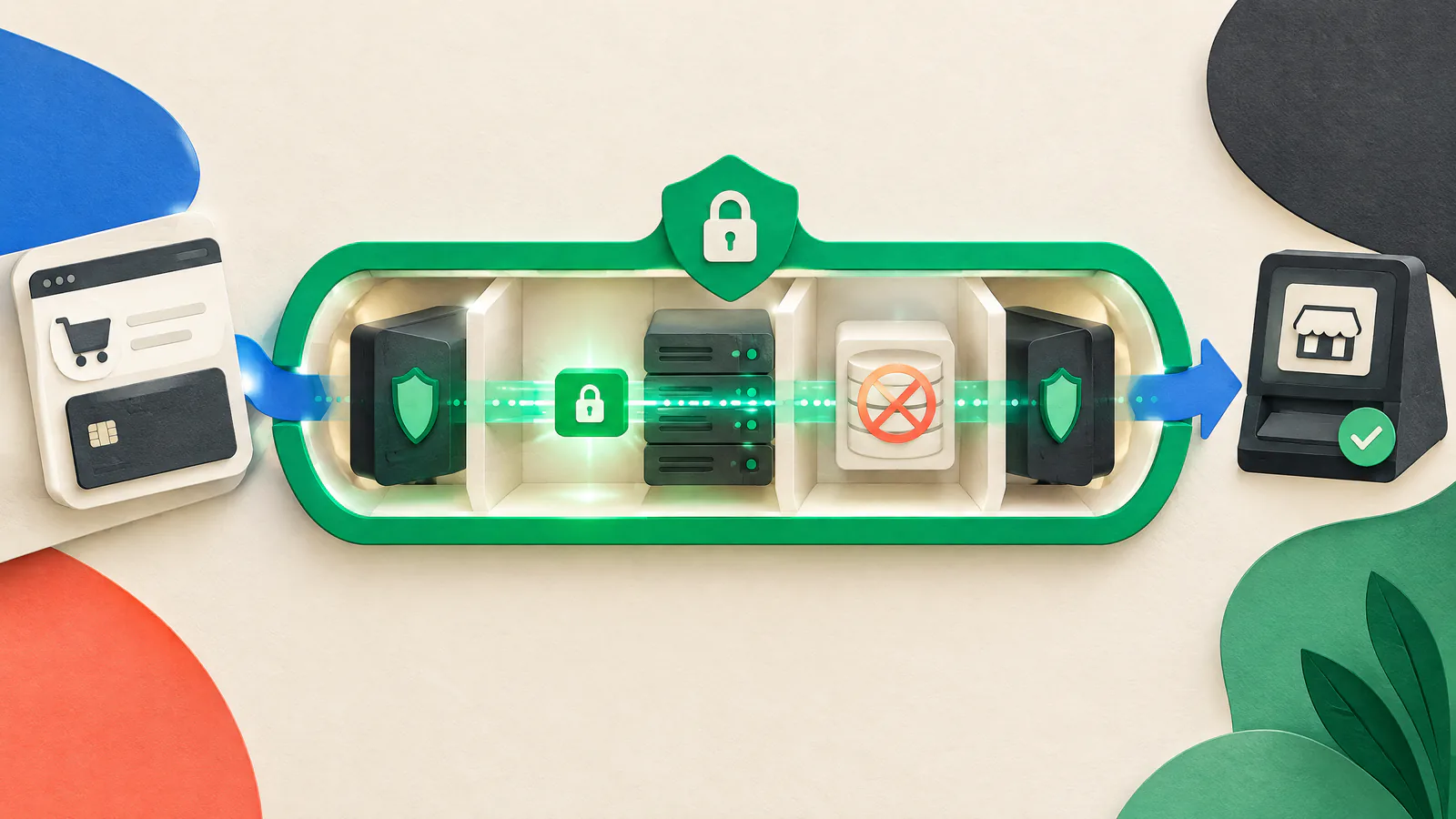
Draw the real payment boundary
Map the buyer path from product page through confirmation. Mark card entry, redirects, frames, scripts, APIs, plugins, tag managers, content delivery networks, and administrator accounts that can influence it. Include related logs, support tools, and analytics. This is a starting record for your provider or assessor, not a compliance decision.
Record the domain serving every payment-page element. PCI SSC says SAQ A eligibility requires all payment-page elements to originate only from PCI DSS-compliant service providers and none from the merchant site. For SAQ A-EP, each element may originate from the merchant or such a provider, but not another source. All other criteria still apply.
A repository can miss tag-manager injections and platform settings. Review scripts, frames, domains, and headers in a normal checkout browser session.
Review logs, analytics, and support workflows for payment fields. Never use real card data in test tickets or shared evidence.
Reduce exposure with an explainable payment model
Where practical, use an integration in which a PCI DSS-compliant provider collects card data rather than your application receiving or storing it. A full provider-hosted redirect is often simpler than a custom form, but embedded fields and iframes can still let your site affect payment. Document the actual integration rather than relying on a hosted label.
Avoid retaining primary account numbers, security codes, checkout-error screenshots, or copied payment details unless an approved design requires it. Encryption helps protect data, but PCI SSC cautions that encryption alone generally does not remove an environment from scope. Confirm token, key, webhook, refund, and responsibility handling with the provider and qualified reviewers.
Keep the integration guide, responsibility information, relevant compliance documentation, and change-notification process with your architecture record.
Do not add marketing experiments, replay tools, chat widgets, or optional libraries without a named owner and review of what they can access.
Control scripts, tags, and headers
Third-party browser code can introduce uncontrolled change, arbitrary code execution, and disclosure to other parties. Keep a checkout inventory with each script’s domain, purpose, owner, approval, and load location. Include tag-manager rules and vendor-loaded code, not only source-tree files.
PCI SSC focuses on authorized scripts, integrity, tamper monitoring, and security-impacting HTTP headers. Approve a baseline, restrict changes, detect differences, and investigate them. A Content Security Policy, or CSP, can restrict resource sources. Where suitable, test it in report-only mode before enforcement. CSP is defense in depth, not a replacement for secure coding or review.
Subresource Integrity can reject a changed external script, but needs compatible cross-origin configuration and can break after vendor updates.
Limit publishing roles, require strong authentication, review custom-code capability, and retain an audit trail.
Limit access and make checkout changes recoverable
Separate routine content publishing from checkout code, payment-provider administration, hosting, DNS, and tag management. Use named accounts, least privilege, and multi-factor authentication where supported. Review access after role changes and remove former employees, vendors, and agencies. Exact PCI DSS applicability depends on the environment, but reducing shared and standing privilege reduces risk.
Use a release process for checkout: named owner, review, test where possible, rollback method, and post-release browser check. Test success and failure paths, redirects, and mobile behavior. Status Is UP supports proactive launch readiness, performance optimization, and rollback planning around releases; it does not determine PCI DSS compliance.
Keep credentials, backup codes, and rollback instructions in approved access-controlled systems, never in tickets, screenshots, or public repositories.
After release, compare browser-visible scripts, domains, and headers with the approved inventory.
Update the stack and verify the result
Maintain an inventory of the commerce platform, plugins, themes, server components, libraries, payment SDKs, tag templates, and services that affect checkout. Subscribe to critical vendor notices. NIST describes patch management as identifying, prioritizing, acquiring, installing, and verifying updates. Record the change, test the payment journey, and confirm what is deployed.
Set an emergency path for high-risk issues and a maintenance window for routine changes. Prioritize exposed checkout components, but do not blindly patch production and break payment. Use a tested rollback approach and provider release guidance. An unknown owner for an outdated component is a risk to resolve.
Keep the advisory, risk decision, test result, deployment record, and final verification together.
Keep evidence and use qualified help
Keep diagrams, provider responsibility information, SAQ eligibility rationale, script and header inventories, access reviews, approvals, test results, changes, and vendor contacts in a controlled location. Refresh them when architecture, ownership, scripts, or providers change. Evidence should help an authorized reviewer without exposing card data, secrets, or customer records.
Your acquirer or payment brand sets applicable validation expectations. PCI SSC identifies Qualified Security Assessors as independent organizations qualified to perform PCI DSS assessments and Approved Scanning Vendors as qualified external scanning providers under applicable requirements. Seek qualified help for custom checkout, unclear scope, suspected compromise, or SAQ selection.
Keep the checkout model, technical owners, escalation contacts, last review date, and evidence links together.